
Medically reviewed by Dt. Mehmet Can Acar
Published on
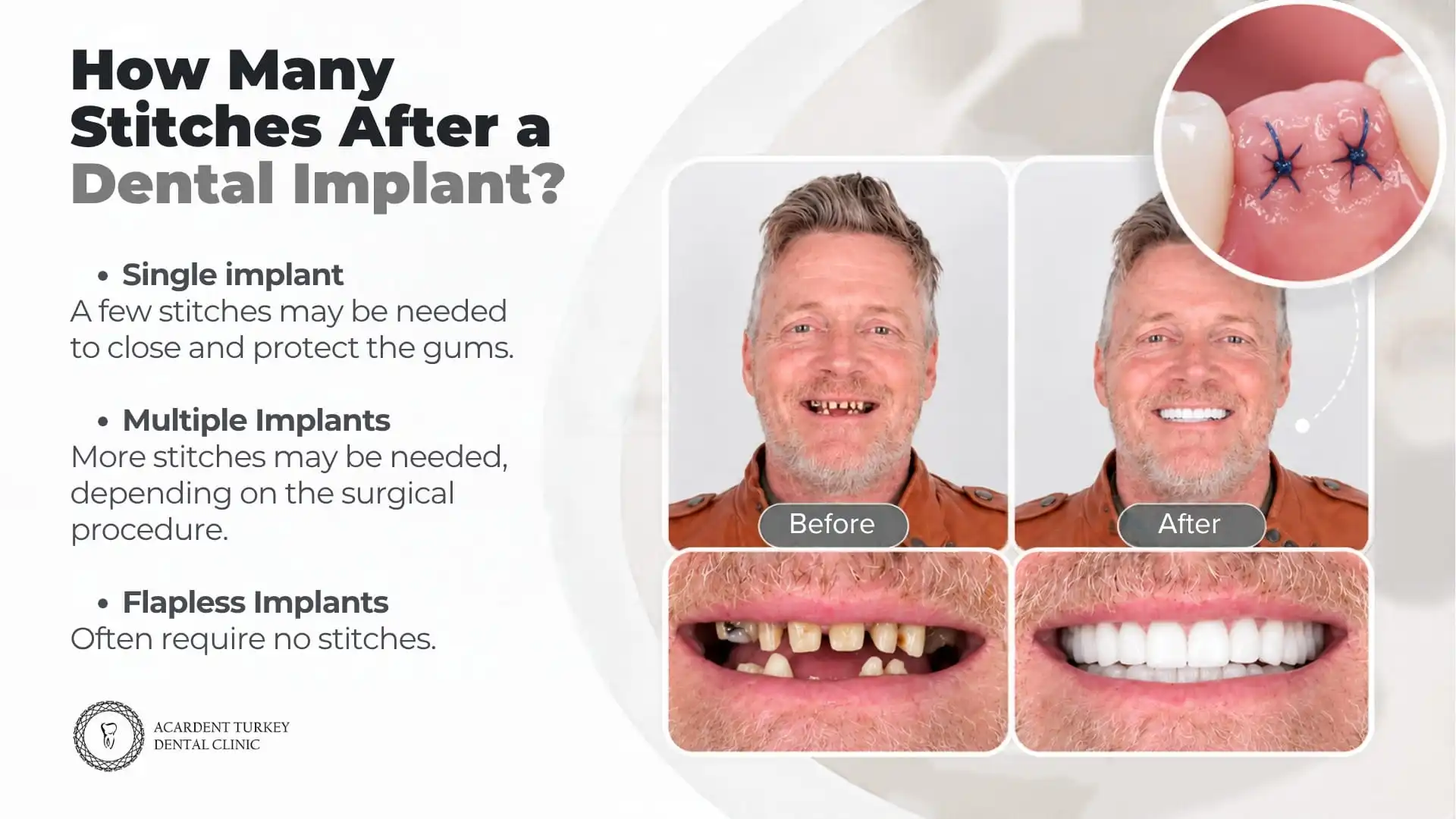
The number of stitches after a dental implant depends on the surgical technique, the size of the incision and whether additional procedures, such as bone grafting, are needed. A single implant may require only a few stitches, while full-arch surgery can require more. Some flapless implant procedures need no stitches at all.
There is no fixed number of stitches for every patient. Your dentist uses as many as necessary to close and protect the surgical area.
Below, we explain what affects the number of stitches, when they are removed and how to care for your gums during recovery.
How many stitches are needed after a dental implant?
A single implant may need only a few stitches; 2 to 4 is an illustrative example, not a fixed clinical requirement. More complex procedures can require additional stitches. There is no fixed number for every patient. The exact number depends on the surgical technique, the size of the incision and whether any additional treatment is needed.
Stitches after a single dental implant
For a single dental implant, the surgeon may use a few stitches to bring the gum edges together and protect the surgical area while it heals.
At Acardent Turkey Dental Clinic in Antalya, the number of stitches is determined by the patient's individual treatment plan and the condition of the surrounding gum tissue.
Stitches after multiple dental implants
Multiple dental implants may require more stitches, especially when several areas of the gum are opened during surgery.
For full-arch dental implant treatment, the number of stitches varies depending on the surgical approach and the extent of the procedure. Some flapless placements may not require stitches at all.
Do dental implants always need stitches?
No, dental implants do not always require stitches.
Some patients receiving dental implants in Antalya, Turkey, may be suitable for a flapless technique, which often requires no stitches. However, when the dentist needs to open the gum to access the jawbone, stitches are usually used to close the surgical area and support healing.
What is a flapless dental implant?
A flapless dental implant procedure is a minimally invasive technique used to place an implant without lifting a large section of gum tissue.
Instead, the dentist creates a small opening in the gum to access the jawbone and place the implant.
Because the gum is not widely opened, stitches are often unnecessary. However, flapless implant placement is not suitable for every patient. The decision depends on bone availability, gum health and the position of the planned implant.
What affects the number of stitches?
The number of stitches depends on the surgical technique, the number of implants and how much gum tissue needs to be opened.
During dental implant treatment in Antalya, your dentist will assess these factors and choose the appropriate surgical approach for your individual needs.
Surgical technique and incision size
A smaller incision generally requires fewer stitches. With a flapless implant technique, stitches may not be necessary at all.
If the dentist needs to lift a wider gum flap to access the jawbone, more stitches may be needed to close the area securely and support proper healing.
Number and location of implants
One dental implant usually needs only a few stitches.
If we place several implants, we work on a larger area. That usually means more stitches. Implants placed in different parts of the mouth may also need separate cuts, so the stitch number goes up.
Bone grafting or additional procedures
Extra works like bone graft, sinus lift or gum graft increase the number of stitches.
These treatments need more space and more tissue work around the implant area. We then use extra stitches to close the gum and protect the graft while it heals.
Do dental implant stitches hurt?
Local anaesthetic is used during implant surgery, so placing stitches should not cause sharp pain. As the anaesthetic wears off, you may feel soreness or tightness. Contact your dentist if pain is severe or getting worse.
How long do dental implant stitches stay in?
The time depends on the suture material and your healing. Non-dissolvable stitches are usually removed around 7 to 14 days after surgery; dissolvable stitches break down gradually.
Dissolvable stitches
Dissolvable stitches often begin to loosen within 1 to 2 weeks, but some materials can remain for several weeks. They usually do not need removal, although your dentist may trim or remove an irritating stitch at a review.
Non-dissolvable stitches and how they are removed
Non-dissolvable stitches are usually removed at a follow-up appointment around 7 to 14 days after surgery. Your dentist sets the timing according to the procedure and wound healing; do not remove them yourself.
The American Academy of Periodontology describes stitch removal after 7 to 10 days for its multiple-tooth implant procedure. This is a removal timeframe, not the number of stitches; follow the date set by your own dentist.
If you come to Antalya for implant treatment, you should plan your trip around this date. So, your dentist can remove your stitches on time, check the implant site and make sure your gum is healing well before you fly.
If your stay in Turkey is shorter, give info to your dental clinic before surgery. They will make a plan for your follow-up and, if needed, arrange for the stitches to be removed by a dentist back home.
How to care for your implant stitches?
For the first few days, be gentle with the area.
What to do
- Eat soft foods in the early period.
- Chew on the other side not to damage the surgery area.
- Drink plenty of water for better healing.
- Brush the untreated teeth gently; follow your surgeon's instructions about when to clean the surgical area.
- Avoid brushing directly over the wound or stitches until your dentist advises it is safe.
- Use any prescribed mouthwash as directed, starting at the time your dentist recommends; avoid vigorous rinsing immediately after surgery.
- Take your medicines as your dentist said.
- Sleep with your head a little higher.
- Go to your dental visits on time.
Call your dentist if a stitch comes loose early.
What to avoid
- Do not touch your stitches.
- Do not pull them with your tongue.
- Do not brush your teeth hard.
- Avoid nuts, crisps, hard bread, etc.
- Avoid chewing gum and sticky sweets.
- Do not smoke.
- Avoid alcohol
- Do not spit hard.
- Do not use a straw at first.
- Avoid heavy exercise for a few days.
- Do not remove the stitches yourself.
When should you contact your dentist about your stitches?
You should call your dentist if something changes in the first few days and does not seem normal.
- If a stitch is loose or falls out in the first 2–3 days.
- If bleeding increases even with you pressing with clean gauze on the area.
- If swelling gets worse after day 3, especially around your jaw, face or neck.
- If you notice pus, a bad taste, bad smell, fever or pain getting stronger.
Call your dentist if the gums around an implant remain red, tender or bleed when brushing. These can be signs of peri-implant disease and need professional assessment.
Implant treatment in Antalya at Acardent Turkey Dental Clinic
At Acardent Turkey Dental Clinic, we provide personalised dental implant treatment in Antalya, Turkey. From your initial assessment to post-treatment care, our team guides you through every step with clear communication and a treatment plan tailored to your needs.
Considering dental implants in Antalya? Contact our team to discuss your treatment options and get answers to your questions.
FAQs
Yes, you can brush your teeth with stitches in your mouth. But you must avoid direct contact with the surgical site and the stitches for the first few days
If your stitch comes out early, the wound can open a little.
If your surgery site still looks closed and clean, leave it alone and keep area clean. Do not pull at your skin or try to fix it yourself!
Visit your dentist if your wound opens more, keeps bleeding, gets more swollen or starts leaking pus. More pain, heat or redness around the area are important signs to call your doctor.
Start with soft foods and chew away from the surgical site where possible. Gradually return to your usual diet when your dentist advises; avoid hard, crunchy or sticky foods near the stitches.
No. In most cases, you do not need to fly back just for stitch removal; a local dentist can usually remove non-dissolvable stitches, while dissolvable stitches come out on their own.
Plan your implant care in Antalya
Visiting Acardent Turkey in Kepez, Antalya? Before you book travel, ask about the planned surgery, stitch type, review date and follow-up arrangements at home. Stitch removal and fitness to fly depend on your treatment and recovery.