

Medically reviewed by Dt. Mehmet Can Acar
Published on
Dental implants can be removed and replaced with a removable prosthesis. However, it is not always necessary to remove every implant. Your dentist might recommend removal if there are issues such as significant bone loss around the implant, infection, or loosening of the implant. Sometimes, patients may simply wish to switch to a different treatment option.
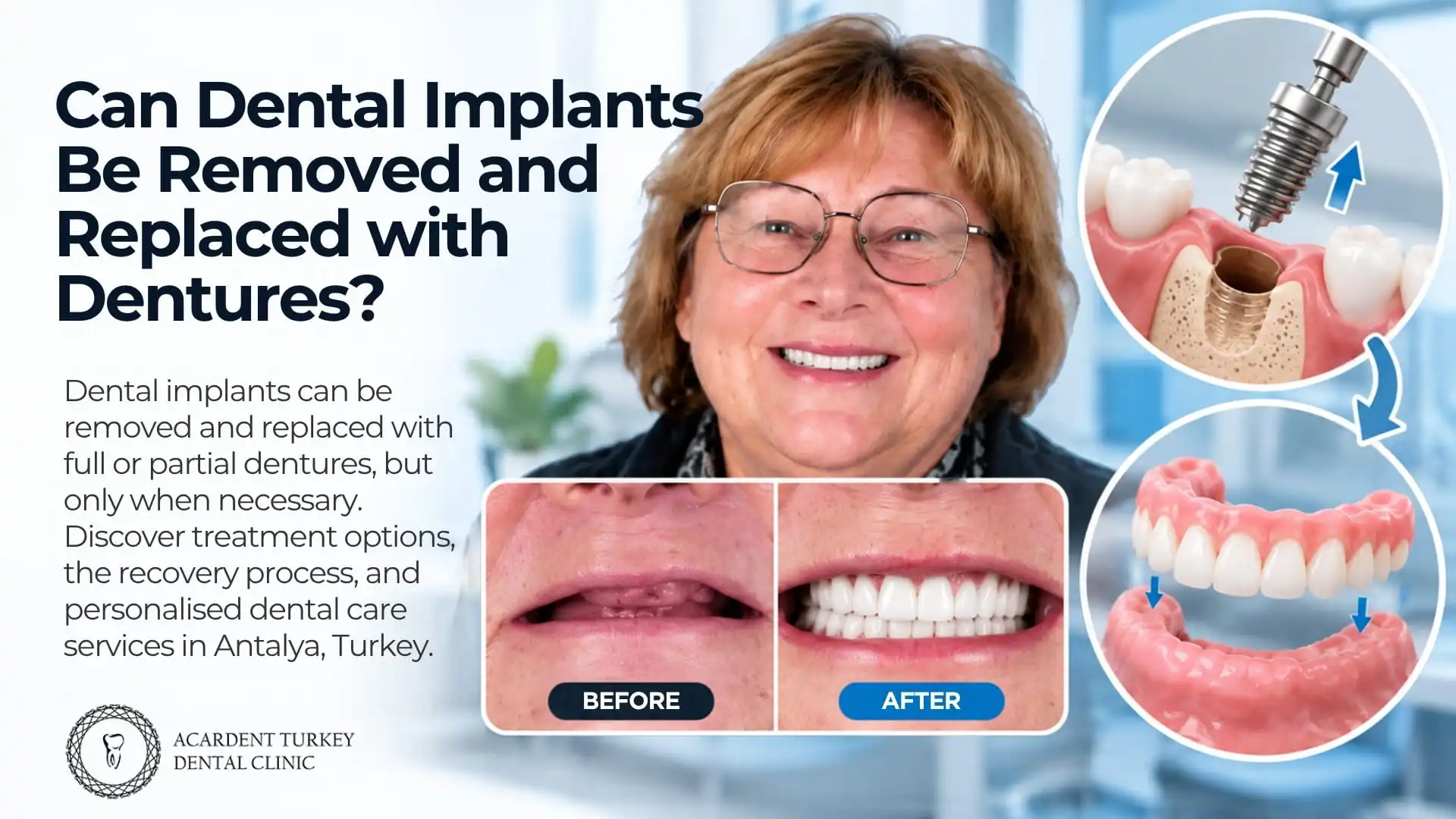
However, the removal of an implant does not necessarily mean you have to switch to a removable denture. If your jawbone and general health are suitable, a new implant may also be considered. Removable dentures are also an alternative for suitable patients. However, dental implants can offer significant long-term advantages due to their fixed nature and chewing comfort. Therefore, it is important to discuss with your dentist whether the existing implant can be preserved and which treatment is more suitable for you before making a decision.
Can dental implants be removed?
Yes, dental implants can be removed. The dentist usually does this in cases of infection, bone loss or problems with osseointegration. There is no need to remove a healthy implant. However, when the problem worsens, the implant ceases to be a solution and becomes a risk.
When does the dentist remove an implant?
Failure of osseointegration: The titanium root fails to fuse with the jawbone. Dentists refer to this fusion as osseointegration (the bone enveloping the implant and holding it as if it were a single unit). If the problem arises in the first few months, this is called early failure. If it occurs months or years later, it is called late failure.
Development of peri-implantitis: This is the inflammation of the gum tissue and bone surrounding the implant caused by bacteria. Smoking, poor oral hygiene and diabetes increase the risk. If treatment is ineffective, the inflammation erodes the bone.
The onset of bone loss: Imagine a parasol pole stuck in the sand. As the waves erode the sand, the pole wobbles and eventually falls over. If the bone surrounding the implant erodes in the same way, the implant becomes loose.
The implant is in the wrong position: The metal part may be visible; chewing and speech may be impaired, and pain may occur. Sometimes a specialist dentist can correct the position. If this does not work, removal may be considered.
Your body rejecting the implant: Although titanium implants are biocompatible, in rare cases your body may reject the implant. In this case, you may experience pain in your tooth and noticeable redness around your gums.
Nerve damage: If the implant comes too close to a nerve during treatment carried out by an inexperienced dentist, you may experience numbness and tingling in your lip, tongue or cheek.
Personal factors may come into play: The cost of maintenance, or a new illness or medication affecting the bone, may make a denture a more suitable option for some patients.
Are there any risks involved in replacing implants with dentures?
Yes, this procedure carries some risks, but the treatment is generally successful. The level of risk depends on how long the implant has been in the mouth, the condition of the bone and gums, and your general oral health.
To remove an implant that has fused with the bone, the dentist may need to cut or reshape the bone. This can slow down the healing process.
So, what can you expect after switching to dentures?
Unlike implants, removable dentures may shift out of place whilst eating or speaking. You may also experience gum sensitivity or, over time, require adjustments to your dentures due to changes in the structure of your mouth. Some people may find it necessary to use denture adhesive to keep their dentures in place more securely.
To minimise the risks, consult an experienced dentist. A personalised assessment at Acardent Turkey Dental Clinic can help you determine the most suitable treatment option for you.
When is it not recommended to replace implants with dentures?
It is generally not recommended to remove a healthy, problem-free dental implant and replace it with a removable denture. It may be more appropriate to preserve the implant, particularly if it is stable and the problem can be resolved with another form of treatment.
So, in which situations might removing the implant be unnecessary or risky?
- Crown or gum problems: A cracked dental crown, a loose attachment screw or mild gum inflammation can often be treated without removing the implant.
- Aesthetic concerns: If you are unhappy with the colour, shape or appearance of your gums, a new crown or gum treatment may be sufficient.
- Health issues: Uncontrolled diabetes and certain conditions that affect healing can increase the risk of surgical complications.
- Risk of bone loss: Removing the implant may damage the surrounding bone.
Should you choose a denture or an implant?
Are dental implants or removable dentures better? There is no single answer to this question. The right choice depends on the condition of your jawbone, your budget and your expectations for daily life.
Dental implants feel more like natural teeth. Thanks to their fixed structure, they can provide greater comfort whilst chewing and speaking. They can also help to limit bone loss by transferring chewing force to the jawbone. However, they require surgery and involve a higher initial cost. For some patients experiencing bone loss, all on 4 or all on 6 treatments may also be an option.
Removable dentures offer a more economical and non-surgical solution. They can be prepared in a shorter time. However, they may become loose over time, irritate the gums and require regular adjustments. They also need to be removed and cleaned daily.
Are you considering dental implant treatment in Antalya?
The specialist team at Acardent Turkey Dental Clinic is here to help you regain your smile. Contact us today for a free consultation to find out whether dental implants or dentures are the most suitable option for your oral health and budget.